
PILLAR GUIDE • THE COMPLETE HUB
The Frozen Block Method: Complete Guide
Updated August 7, 2026 16 min read
 Updated August 7, 2026
 16 min read
On this page
- Three categories, one rule, half a cup
- What is the frozen block method?
- How does the frozen block method work?
- Why are frozen blocks half a cup?
- How many dinners can you make from a few blocks?
- What is not the frozen block method?
- One tray, and honest credit for who made it
- What do you need to start the frozen block method?
- What’s new about the frozen block method – and what isn’t?
- What goes in the categories, and what’s in a block
- What are the three foundation categories?
- What’s actually in a three-block dinner?
- What about meal blocks and smoothie packs?
- What it solves, and how to steer it
- What does the frozen block method actually solve?
- How do you adjust the frozen block method for your goal?
- Frequently asked questions
- The system on paper
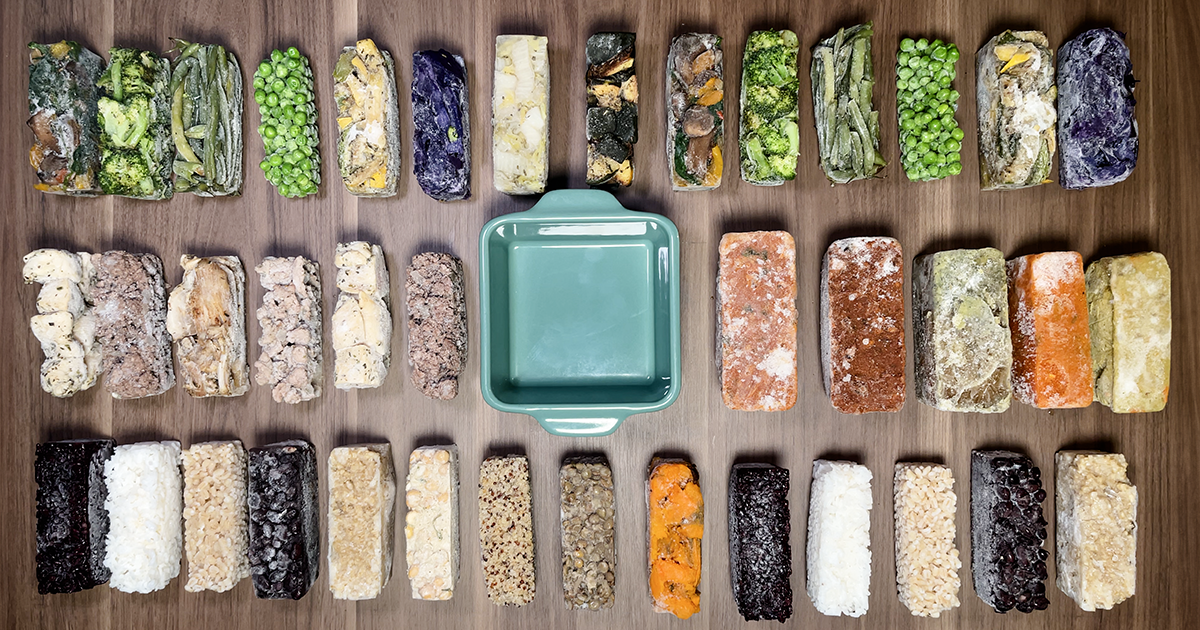
The frozen block method is the batch cooking system I run my kitchen on. Three foundation categories – protein, carb, veg – frozen in standardized half-cup portions called blocks, and one rule for combining them: pull one from each category, heat, eat. That’s the whole system. It fits in a sentence on purpose, because a system you have to remember is a system you’ll abandon by March.
I’ve been batch cooking for ten years. The frozen block method is about one of them. That gap is the story – nine years of trying approaches and watching them fall apart, cooking constantly and still not eating the way I wanted, before I finally asked what it would actually take to eat well without fighting for it every single night. This page is for anyone in year nine of that: you can cook, you’ve tried meal prep, and it keeps not sticking.
This is the reference page for the whole system – what it is, why it’s shaped this way, what’s actually in a block, and what it solves. It’s not the how-to. The step-by-step lives in the Playbook, and the guides linked throughout go deep on the individual parts. Four sections: what the method is, the tool that makes it work, the blocks themselves, and how to run it toward a specific goal. Not sure where to start? Pick the path below that sounds most like you.
Not sure where to start?
Pick the one that sounds most like you.
New to this
You've heard the term. Start with what it is and why half a cup is the unit.
Start with the basics →Have the trays
You've got the gear. Skip to the categories and what to batch first.
Go to the blocks →Chasing a goal
Protein, calorie control, or no time. Same three categories, pointed at what you want.
Steer the system →Three categories, one rule, half a cup
The definition, the arithmetic behind it, and what the method is not. Start here if the term is new to you.
What is the frozen block method?
The frozen block method is a batch cooking system that freezes cooked food in standardized half-cup portions called blocks, sorted into three foundation categories – protein, carb, and vegetable – and combines them into dinners with one rule: one block from each category. You cook components whenever it suits your week, freeze them in silicone trays, and build meals from the freezer instead of deciding at 6:45pm.
Three categories, one rule, half a cup. Everything else in this guide is why each of those is what it is.
Two optional extensions run on the same system. Meal blocks are one-cup portions of complete dishes – chili, stew, curry – that stand as dinner on their own. Smoothie packs are four quarter-cup portions that make one blend. Neither is required. The foundation is the method; the extensions are things you add once it’s running.
Beans are carbs, not protein. That surprises people until they look at the macros.
How does the frozen block method work?
It works in three moves: cook in categories, freeze in blocks, combine at dinner. You’re not making meals ahead. You’re making the parts of meals, and the meal gets assembled the night you eat it.
Cook in categories. A batch of ground beef. A tray of roasted sweet potato. A big vegetable sauté. Each one is a single decision that produces six dinners’ worth of one component.
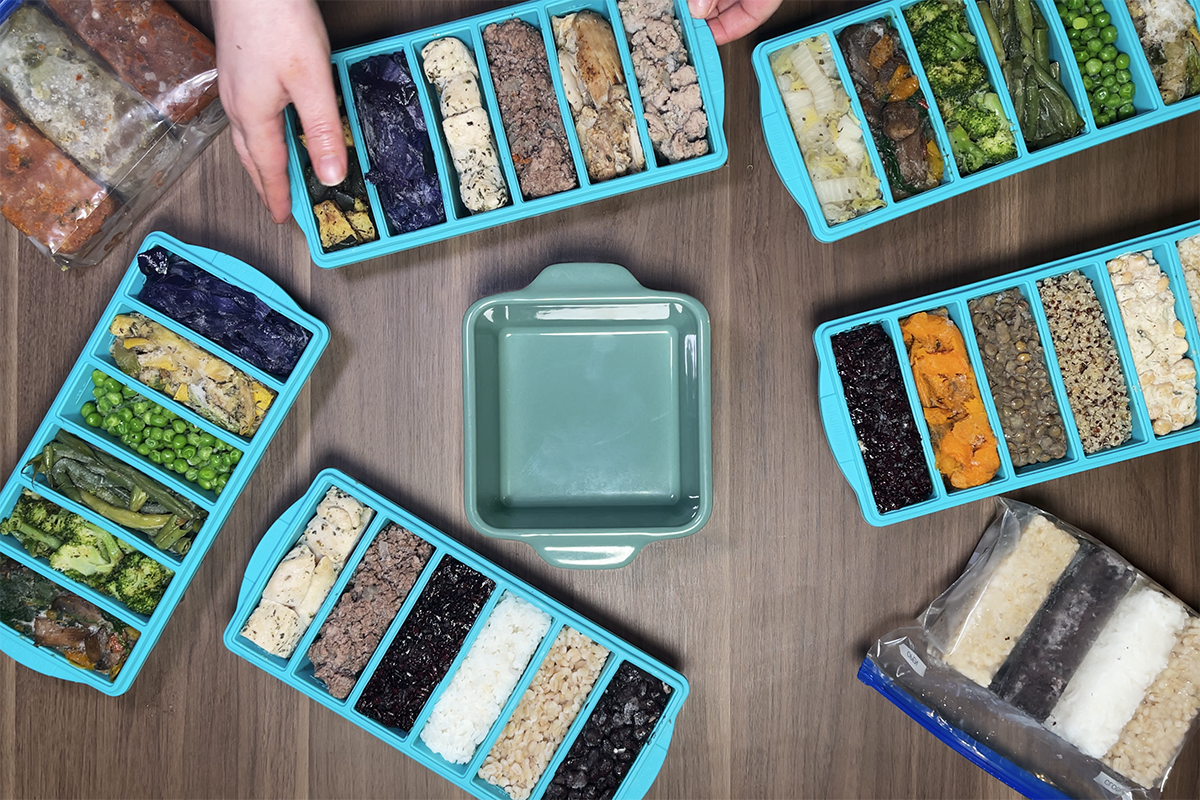
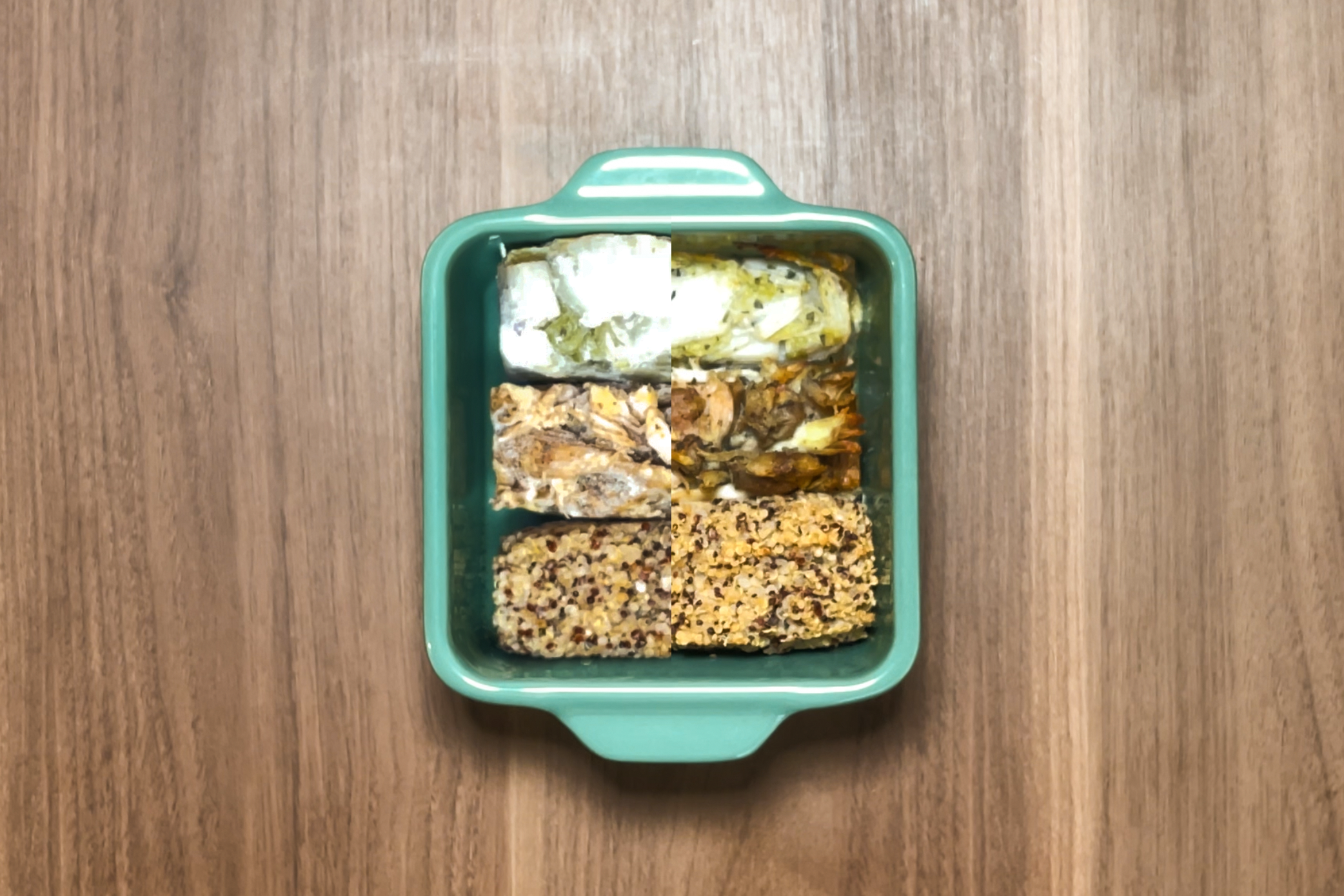
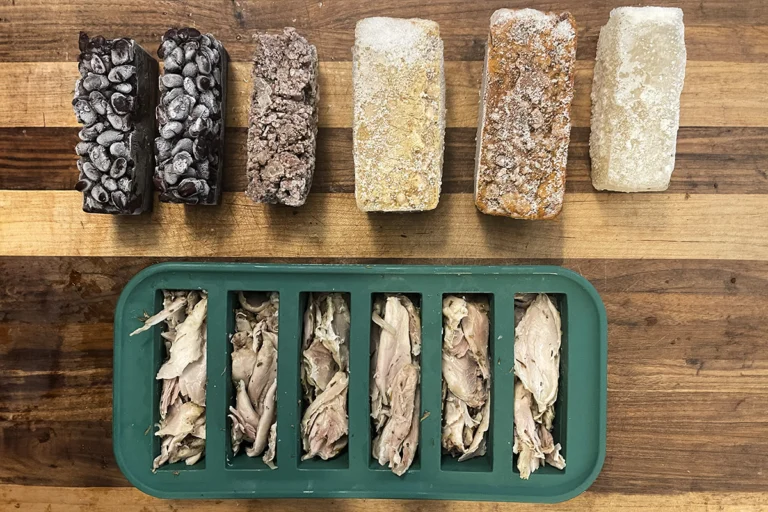
Freeze in blocks. Spoon the cooked component into a half-cup silicone tray, freeze it solid, pop the blocks out, and bag them by type. What comes out is a drawer of identical, labeled, stackable portions. Not a container of food you’ll dig through – discrete objects you can count.
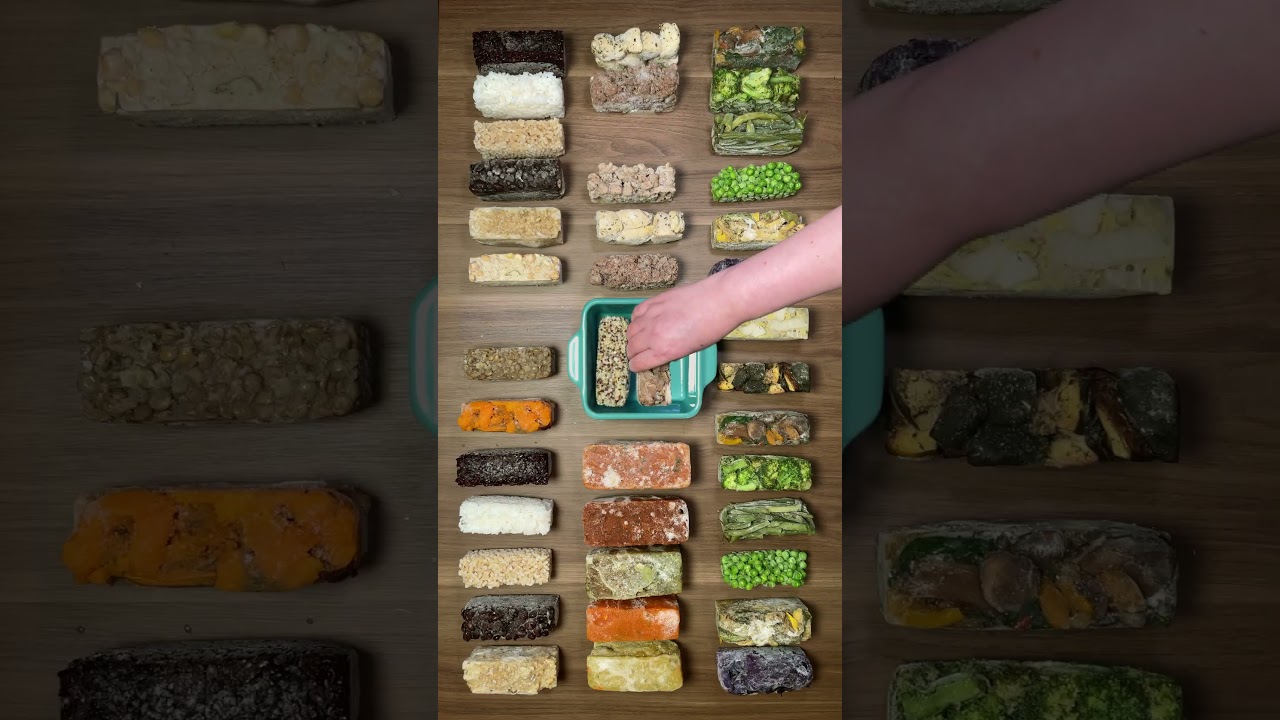
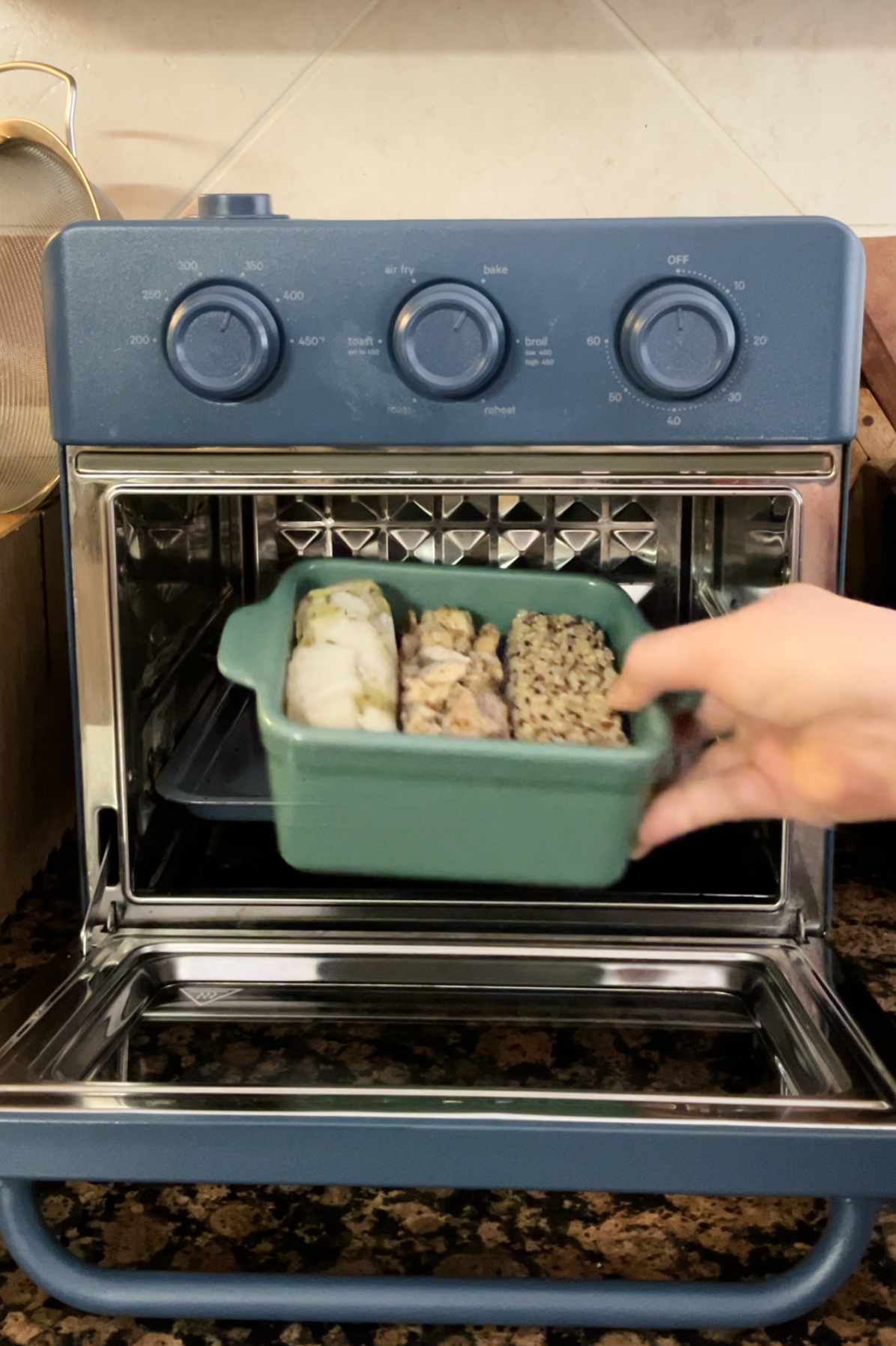
Combine at dinner. Pull one protein, one carb, one vegetable. Heat them together. Add a sauce if you want one. Thirty minutes later dinner is on the table and you made no decision harder than “which three.”
The reason this holds up is that the combining rule forces a balanced plate without you tracking anything. One protein, one carb, one vegetable is the same split the USDA’s MyPlate recommends – so following the rule keeps you fed properly with no macros, no meal planner, no decision fatigue. The only way to get it wrong is to pull three blocks from the same category.
Why are frozen blocks half a cup?
Because three of them is a dinner. A standard balanced plate is about a cup and a half of food, and a cup and a half divides three ways into protein, carb, and vegetable. Half a cup is a third of a meal. That’s the whole derivation, and it’s the reason the number is what it is.
I want to be precise about the direction of that, because it’s easy to tell backwards. It would be tidy to say I measured my way to half a cup and then went looking for a tray. I didn’t. The half-cup silicone tray already existed and I was already using it. But the reason it stuck – the reason I didn’t drift to another size – is that three blocks from that tray lands on a real portion of food. Had the tray been two-thirds of a cup, the math wouldn’t close and I’d have gone looking for a different tray.
The plate picked the number. The tray just happened to already make it.
What that buys you is a system where nobody measures anything again. You’re not portioning by weight or eyeballing a serving. You’re pulling three identical objects out of a drawer. That’s what makes it survive 6:45pm on a Tuesday when you’ve got nothing left to give.
And a standard portion isn’t a prescription. Bigger appetite, longer day, heavier training – add a block. Lighter – pull two and finish with a sauce. Because every block is the same size, adjusting is one move instead of a recalculation. The standard is precisely what makes it flexible, which is the opposite of what people assume when they hear “standardized portion.”
How many dinners can you make from a few blocks?
More than you’d think, and the growth is multiplicative rather than additive. Two proteins, two carbs, and two vegetables is eight distinct dinners from six batching decisions. Go to four proteins, three carbs, and three vegetables and you’re at thirty-six.
That’s the property that kills flavor fatigue, and it’s the real difference between this and meal prep. When you cook five identical containers on Sunday, Wednesday-you is eating Sunday-you’s decision for the fourth time. When you freeze components, the choosing happens at dinner, takes three seconds, and can be different every night from the same small library.
Add one new block to a stocked freezer and you don’t add one dinner. You add a row of combinations. That’s why a modest freezer runs 60+ dinners without feeling repetitive, and it’s the same arithmetic behind lego lunch meal prep if you want to see it worked through for lunches.
What is not the frozen block method?
Freezing components isn’t the frozen block method – it’s the raw material for it. What makes it a system is the standardized half-cup portion and the one rule: one protein, one carb, one veg. Want a sauce block, a meal block, a smoothie pack? Same idea, different size. But without the portion and the rule, you’re just freezing food.
It isn’t meal prep. Meal prep means cooking complete meals and portioning them, so Sunday’s decisions lock your whole week. Blocks stay separate, so the week stays open. Same afternoon of cooking, completely different result.
It isn’t leftovers. Leftovers are the half-pot of curry you didn’t finish. Blocks are portioned deliberately and frozen at their best, then reheated as a first serving rather than a second one. People who swear they hate leftovers generally don’t react to blocks the same way.
It isn’t once-a-month cooking, and it isn’t a Sunday marathon. That’s the part most batch cooking guides get wrong – they treat the big planned session as the whole practice, so the first missed Sunday takes the system down with it. Blocks accumulate however they accumulate. Twenty minutes on a Tuesday counts. The freezer doesn’t care how you got there.
And it isn’t less cooking. The cooking still happens. It just happens when you have the bandwidth instead of at the moment you have the least. The thinking is what got easier, and the thinking was always the expensive part.
-
 10 min read
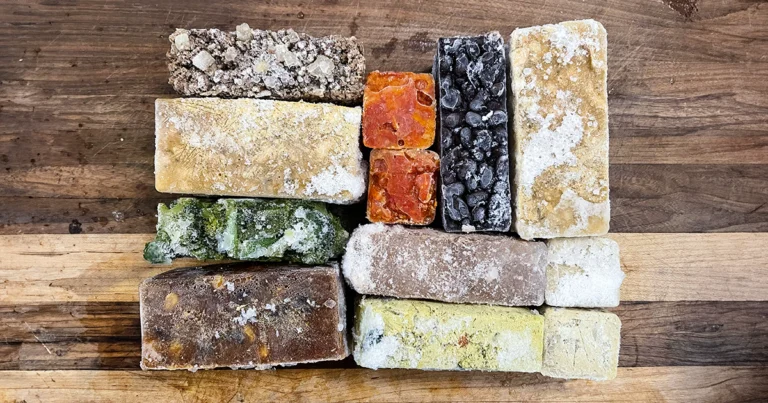
Lego Lunch Meal Prep: The Frozen Block Method
The block method applied to lunch, with the combination math worked all the way through. The clearest worked example of the system on the site.
Read → -
 14 min read
The Complete Guide to Batch Cooking
Batch cooking is the activity; the frozen block method is the system that organizes it. This guide covers the session itself – the order of operations and what's worth making.
Read →
One tray, and honest credit for who made it
The half-cup silicone tray is the only required gear. Here’s what it does, and what I did and didn’t invent.
What do you need to start the frozen block method?
One half-cup silicone freezer tray. That’s the entire required equipment list, and it’s about fifteen dollars.
The tray is doing more work than it looks like. The portion size comes from the tray. The shape comes from the tray. The fact that blocks pop out clean, stack without a fight, and freeze in identical portions every single time – all the tray. Could you do this with mason jars, deli containers, or freezer bags? Technically. The system works in principle. In practice you’d be measuring half-cups by hand into containers that don’t stack, which is exactly the friction the method exists to remove.
If you want to run everything here, two more are useful but optional: a quarter-cup tray for smoothie packs, and a one-cup tray for meal blocks. Start with one half-cup tray. Most people end up with two or three within a few weeks, because once you’re batching regularly you don’t want to wait for the first tray to freeze before starting the next thing.
Beyond that: a sheet pan, a skillet, and whatever you already own. A pressure cooker earns its place fast if you make beans. There’s no gear tier to climb.
What’s new about the frozen block method – and what isn’t?
Almost none of the individual pieces are new, and I’d rather say that plainly than have you find out on your own. Cooking components separately and freezing them in portions is old. Home cooks have done it for generations. Food blogs have written about it for years.
The tray isn’t mine either. Souper Cubes invented that category and makes the best version of it, and every block I make is sized for their half-cup tray. Any half-cup silicone tray works the same way – the brand isn’t sacred, the portion is – but credit belongs where it belongs. If you want the details on sizing and use, how to use Souper Cubes covers it properly.
What I developed is the system around those pieces. I named the block. I drew the lines between the three foundation categories, including the unglamorous calls like putting beans in carbs. I standardized the portion and worked out that three of them is a plate. I wrote down the one combining rule that makes it run without recipes. And I built the app to track it, because running the system in my head week after week is what actually broke first.
That’s a smaller claim than “I invented a way to cook,” and it’s the honest one. The value was never in any single piece. It’s that the pieces now have names, sizes, and a rule, so the system fits in your head and you can hand it to somebody else. I batch cooked for nine years without that and watched it fall apart on me over and over. One year with it and the freezer has never fully gotten away from me. The arrangement is the whole difference.
-
 8 min read
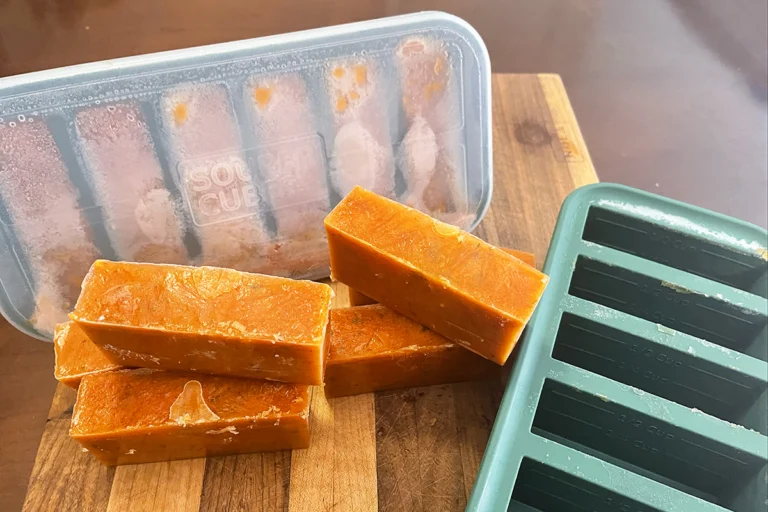
How to Use Souper Cubes
Sizing, filling, freezing, and popping out clean. The practical guide to the one piece of gear the system depends on.
Read → -
 9 min read
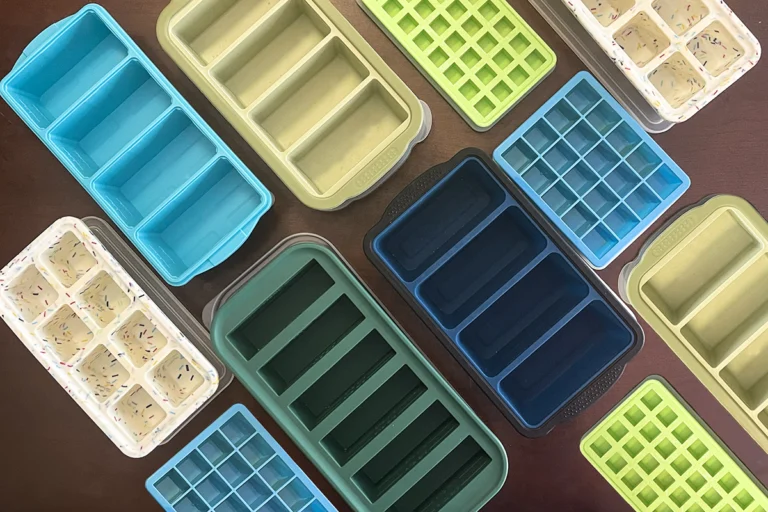
The Souper Cubes Freezer Tray Review
An honest look at the tray after a year of near-daily use – what holds up, what doesn't, and which size actually earns counter space.
Read → -
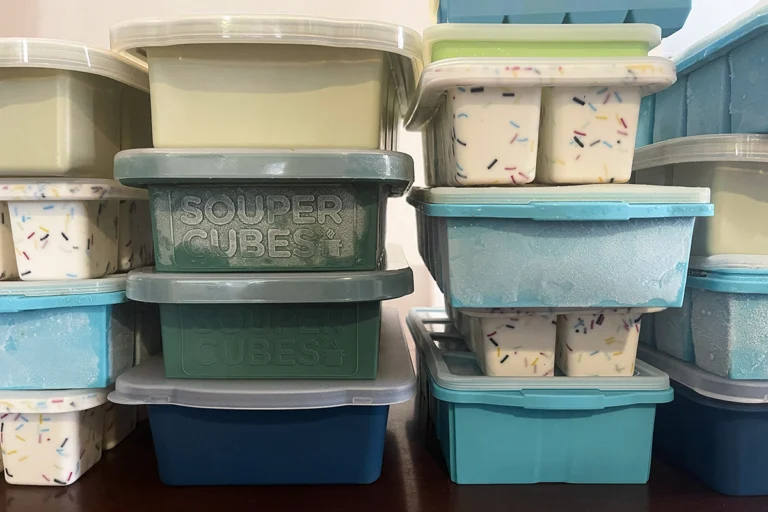 7 min read
Are Souper Cubes Worth It?
Whether the tray justifies its price against cheaper silicone alternatives, and when a regular container genuinely does the job.
Read →
What goes in the categories, and what’s in a block
The three foundation categories in depth, the calorie numbers behind them, and how the optional extensions work.
What are the three foundation categories?
Protein, carb, and vegetable. Every foundation block you make falls into exactly one of them, and that’s what makes the combining rule work.
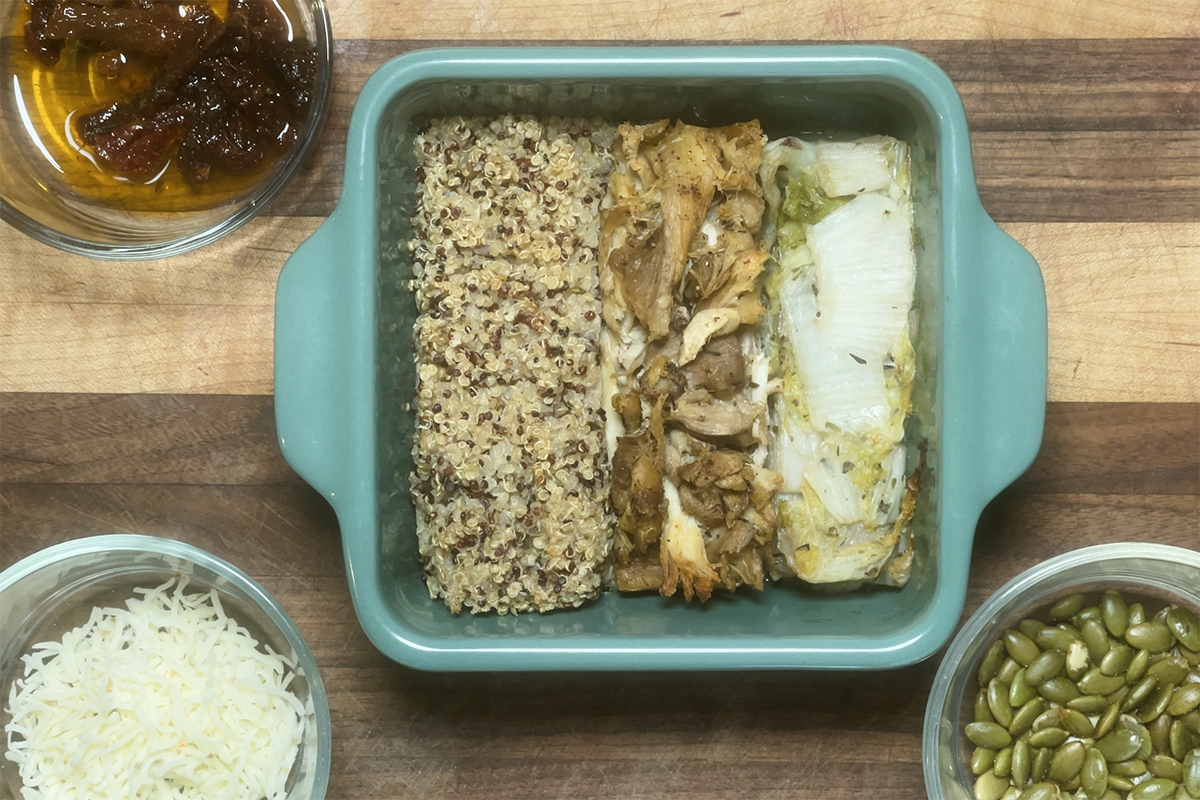
Protein anchors the plate. Ground beef, ground turkey, chicken bites, shredded chicken, fish, tofu. This is the most expensive category, so batch it strategically – smaller amounts more often rather than one enormous session that eats your whole freezer.
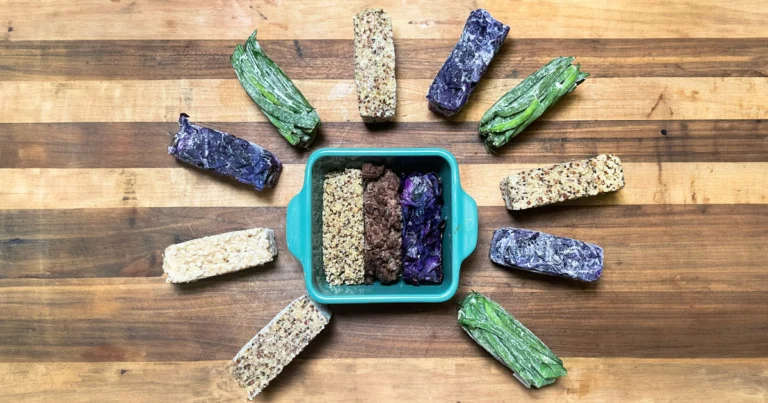
Carbs are the energy. Sweet potato, rice, black rice, barley, quinoa, steel-cut oats, black beans, chickpeas, lentils. This category is cheap and does a lot of the heavy lifting. Beans especially – pressure-cooked from dry they’re nearly free per serving and they’re the most filling block in the system.
Vegetables are where you go hard, because they’re cheap and they make everything look and taste like a real meal. My default is a mixed sauté – onions, peppers, mushrooms, spinach – which goes with everything precisely because it’s already a mix. Cabbage, purple cabbage, broccoli, green beans, peas, and squash all block well on their own.
The lines matter more than the contents. Beans are carbs. Peas are a vegetable that behaves like a carb. What fills each category is entirely yours – some people run five proteins, some run two vegetable sautés in rotation. The categories and the rule stay the same. Souper Cubes recipes has the full roster of components that block well if you want somewhere to start.
What’s actually in a three-block dinner?
Roughly 240 to 460 calories depending on which three blocks you pull, with a typical build landing around 350. Here’s the range by category, calculated from USDA FoodData Central values against my actual recipes, with cooking oil counted in every vegetable block.
| Category | Lightest block | Heaviest block |
|---|---|---|
| Protein (½ cup) | Shredded chicken ~140 | Ground beef 85/15 ~230 |
| Carbs (½ cup) | Sweet potato ~60 | Chickpeas ~135 |
| Veg (½ cup, with oil) | Cabbage ~40 | Peas ~95 |
The lightest dinner from my usual library is shredded chicken, sweet potato, and cabbage, at about 240. The heaviest is ground beef, chickpeas, and peas, at about 460. Everything else falls in between.
Two things worth knowing. Peas are the outlier in the vegetable category – at roughly twice the density of green beans they behave more like a light carb, which matters if you’re watching the number. And every vegetable block carries the oil it was cooked in, usually 25 to 35 calories, which is the single most overlooked line in anyone’s mental math.
Notice what the rule does here. Individual blocks vary by about six times, from a 40-calorie cabbage block to a 230-calorie beef block. Dinners built from them vary by less than two. Because you always pull exactly one from each category – and proteins are consistently dense while vegetables are consistently light – the structure absorbs the variance. I didn’t design that. It fell out of the category rule and I only found it when I sat down and did the arithmetic. But it’s why the system can be this loose and still be reliable.
These are calculated figures, not lab numbers. Treat them as directional.
What about meal blocks and smoothie packs?
They’re optional extensions, and they run on the same system with a different portion size.
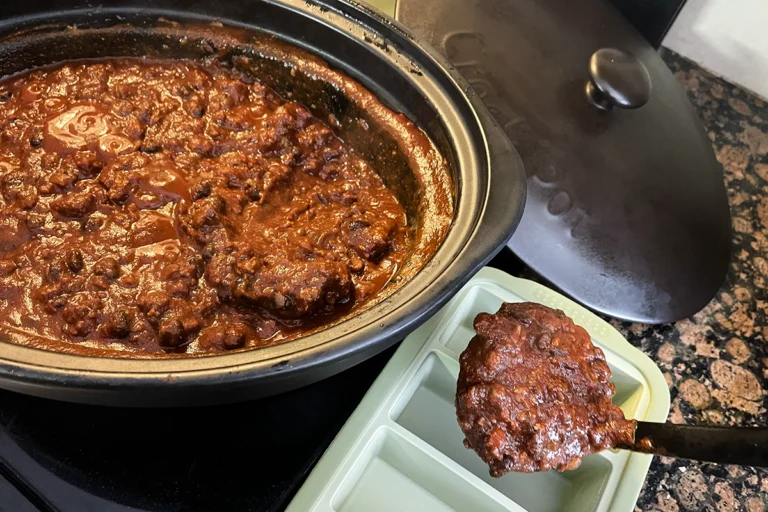
A meal block is a one-cup portion of a complete dish – chili, white chicken chili, tikka masala, stew, soup. Dinner on its own. But meals aren’t an island: pair a chili block with a rice block and one block becomes two dinners. The meal does the work of the protein and the sauce; foundation blocks fill in the rest.
Not all meals are equal, and this is where most batch cooking guides go sideways – they treat the ambitious pot of something as the whole point. Chili is barely more work than making a beef block and a bean block separately. Tikka masala is a whole afternoon. So the priority order is foundation first, always; easy one-pot meals next; complex project meals last, and only once the food that actually feeds you every day is stocked. Freezer meal prep ideas covers the whole-meal side properly if that’s the direction you want.
A smoothie pack is four quarter-cup portions frozen in a separate tray – fruit, greens, seeds, whatever you build yours from – grouped to make one blend. Smoothies don’t combine with anything. A smoothie is its own whole thing, and the easiest breakfast in the world.
Meal blocks are the one place the calorie math gets loose. A tomato soup and a tikka masala with cream aren’t in the same universe. Pair a meal block with a vegetable block and the plate is balanced regardless of what’s in it.
-
 12 min read
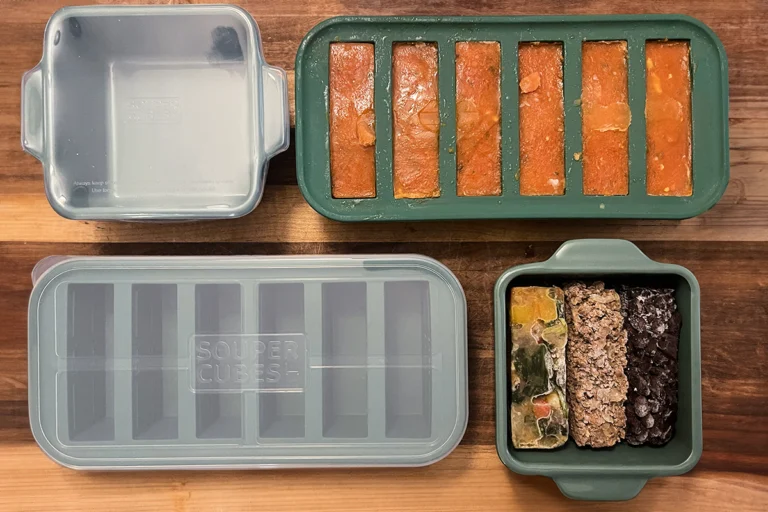
Souper Cubes Recipes: 30+ Meal Block Ideas and Combos
The full roster of components that block well, sorted by category, with the combinations that actually work together.
Read → -
 15 min read
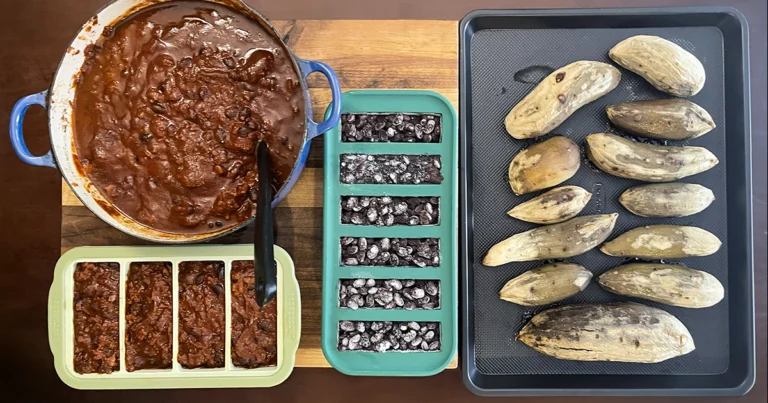
Freezer Meal Prep Ideas: 50+ Make-Ahead Meals
When you want whole meals instead of components – what freezes well, what doesn't, and how to build a meal block worth the freezer space.
Read →
What it solves, and how to steer it
Food waste, speed, and the payoffs nobody mentions – plus how to point the same three categories at a specific goal.
What does the frozen block method actually solve?
Four things, and only one of them is the one people expect.
Food waste. USDA estimates the average American family of four loses $1,500 a year to uneaten food, and nationally 30 to 40% of the US food supply goes uneaten. A lot of the household share dies in the freezer, pushed to the back and forgotten – not because you didn’t want it, but because nothing told you it was there. Blocks fix that structurally: portioned means you thaw exactly what you need, labeled and bagged by category means you can see what you have, and frozen means the clock stops. I almost never throw food away now, and that’s not discipline. It’s that the food is visible and portioned.
Speed. Thirty minutes from freezer to table, and most of it is oven time you’re not standing over.
The sick-day freezer. You get the flu and there’s already real food. Not canned soup food – real, portioned, ten-minutes-of-effort food. The version of you who can barely stand doesn’t have to order delivery or eat crackers for three days. Open the freezer, pull three blocks, the oven does the rest. Nobody mentions this when they’re selling you on batch cooking, and it might be my favorite part of the whole thing.
The travel-home dinner. You land at 9pm, exhausted, nothing fresh in the fridge because you’ve been gone four days. Thirty minutes from the front door to eating real food. Travel is meaningfully less brutal when you’re not also coming home to a kitchen problem.
And underneath all of it: eating well by default. When the freezer is stocked with real food in real portions, the easy choice is finally also the good one. I stopped choosing between what I wanted to eat and what was fast, because the system collapsed those into the same thing.
The honest part: the freezer empties faster than you expect, and it doesn’t fall apart all at once – it falls apart one category at a time. The fix isn’t discipline. It’s noticing what’s low before you run out.
How do you adjust the frozen block method for your goal?
At the batch session, not at the plate. That’s the whole trick, and it’s what standardized portions actually buy you.
The block is a unit of adjustment. Batch shredded chicken instead of ground beef and every dinner for the next two weeks is about 90 calories lighter – no decision at dinnertime, nothing tracked, nothing measured. Swap cabbage for peas and you’ve gone the other way. You’re not counting calories at dinner. You chose them once, at the batch session, for weeks at a time.
Chasing protein? Weight the protein category and pull four blocks instead of three – two proteins, a carb, a veg. Because the portions are fixed, you know exactly what a second protein block adds without opening an app. High-protein freezer meal prep works this through with the per-block numbers.
Cutting? Build a lighter library. Shredded chicken, sweet potato, cabbage lands around 240 a plate before sauce. You didn’t restrict anything at dinner. You just made different blocks.
Short on time? The slow cooker does the work while you’re not home, and a big batch portions straight into trays. Crock pot freezer meal prep covers that workflow – it’s the opposite of the raw dump bag, and it blocks beautifully.
The system doesn’t care which goal you’re running. It’s the same three categories and the same rule. What changes is which blocks you make.
-
 13 min read
The Complete Guide to High-Protein Freezer Meal Prep
Hitting a protein target inside the block system – which proteins block best, and how to weight the categories without tracking macros.
Read → -
 11 min read
Crock Pot Freezer Meal Prep: A Complete Guide
Slow cooker batches that portion straight into trays – the opposite of the raw dump bag, and the lowest-effort way to stock a category.
Read →
Tools, downloads & references
Frequently asked questions
Frequently asked questions
What is the frozen block method?
Why are frozen blocks half a cup?
How is the frozen block method different from meal prep?
How many calories are in a three-block dinner?
How long do frozen blocks last?
Do I need Souper Cubes for the frozen block method?
How long does a batch session take?
What if I only cook for one or two people?
Are beans a protein or a carb in the frozen block method?
Did Haley Ross invent the frozen block method?
The system on paper
This page is what the frozen block method is and why it’s built this way. The Playbook is how you run it — every category, every portion, every combining rule, plus the four cooking modes that carry it through a real week. Free PDF, about a 20-minute read. Cook one protein, one carb, one vegetable this weekend. That’s the whole beginning.
Get the Playbook →

Be the first to leave a comment