
Bulk Cooking 101: How to Cook Once and Eat All Week
Bulk cooking means running several batches in one session – one meat, two vegetables, two carbs is the minimum viable week for one person – and eating from the freezer for the days that follow. The honest timeline: about 3.5 hours of cooking on day one, an overnight freeze, and ten minutes of bagging blocks on day two. You don't need a warehouse membership; a regular grocery run covers a one-person week. Variety comes from toppings and swapping the sides, not from cooking extra proteins.
On this page
- TL;DR
- What does bulk cooking actually involve?
- Can you really cook once and eat all week?
- What should you cook for a week of bulk cooking?
- How do you bulk cook a week of food in one session?
- Do you need to buy in bulk for bulk cooking?
- How do you keep a week of the same food from getting boring?
- What about bulk cooking for a family?
- Frequently asked questions
- Conclusion
- Start this Sunday
TL;DR
Bulk cooking means running several batches in one session (one meat, two vegetables, two carbs is the minimum viable week for one person) and eating from the freezer for the days that follow. The honest timeline: about 3.5 hours of cooking on day one, an overnight freeze, and ten minutes of bagging blocks on day two. You don’t need a warehouse membership; a regular grocery run covers a one-person week. Variety comes from toppings and swapping the sides, not from cooking extra proteins.
Bulk cooking gets sold with a picture of a Costco cart: forty pounds of chicken, a chest freezer in the garage, a Sunday that disappears into steam. That picture is exactly why most people never try cooking a week of food at once. It looks like a lifestyle commitment when it’s actually one afternoon.
Here’s the reframe this whole guide runs on: the bulk in bulk cooking is about the cooking, not the buying. You don’t need to shop like a restaurant. You need one regular grocery run, one 3.5-hour session with the oven and two burners working, and a freezer with one empty drawer.
This is the honest version of cook once, eat all week. I’ll give you the exact five things I’d cook for a one-person week and the order to cook them in so a single oven covers it. I’ll also tell you the part the tidy versions skip, why “one day” is really a day plus ten minutes tomorrow, and what actually changes when you’re feeding four instead of one.

What does bulk cooking actually involve?
Bulk cooking is cooking several things at once, in one session, so you eat from that work for a week or more instead of starting dinner from scratch every night. It’s the whole-afternoon version of cooking: the oven, both burners, and the counter all going on different components, with everything portioned into the freezer at the end.
Plenty of people use bulk cooking and batch cooking to mean the same thing, and there’s no official dividing line between them. The way I think about it: a batch is one big pot of a single thing, and a bulk session is a bunch of those batches in one day. But don’t get hung up on the words. The useful part is the session itself, and if you want the broader practice, my complete guide to batch cooking goes wider.
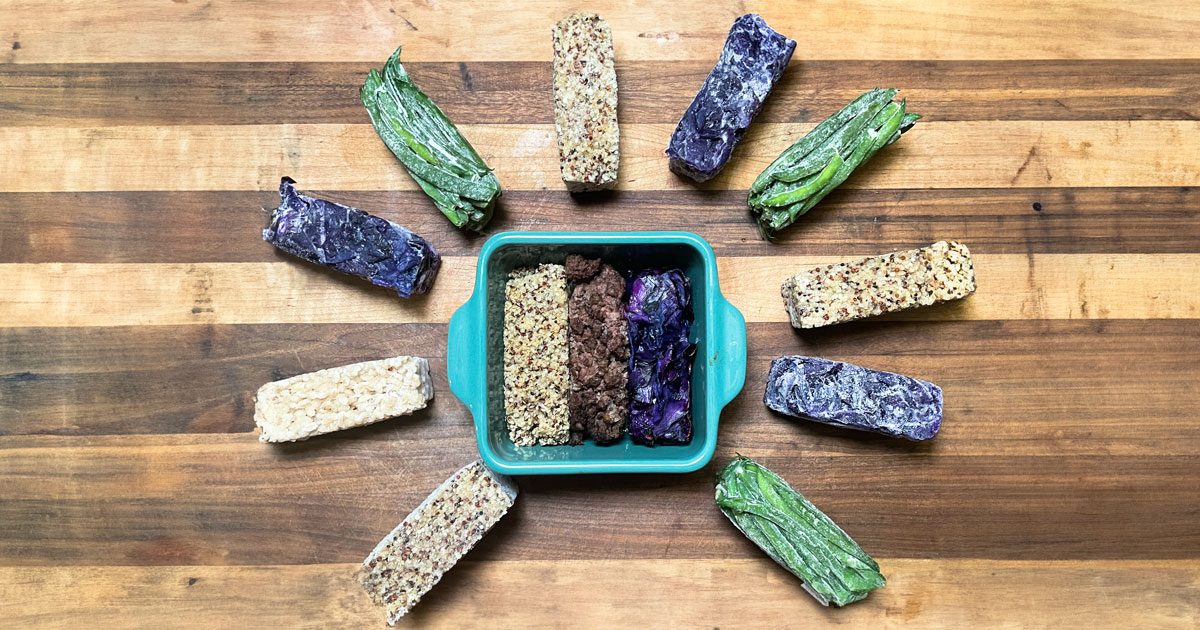
Once it’s cooked, I organize what comes out with the frozen block method: everything gets portioned into standardized half-cup frozen blocks, sorted by category, so dinner later is pulling one protein, one carb, and one vegetable from the freezer. This post isn’t about the system, though. It’s about the day.
Can you really cook once and eat all week?
For one person, yes: one 3.5-hour session genuinely covers a week of weekday lunches and dinners. For a family of four it’s more of a stretch, and how much of a stretch depends on what you cook and how comfortable you are in the kitchen. The bigger the household, the more the weekend cook shifts from making a week of finished meals to stocking a few components you build on during the week. It still works. It’s just a different shape, and there’s a section on it below.
And even the one-person version isn’t literally one day, if we’re being technical, and being technical is the point of this post. The food cooks in one session, but the blocks freeze overnight in their trays, and the next day you spend ten minutes popping them out and bagging them by type. You can skip that and leave everything in trays, but then your trays are tied up all week. Sweet potatoes are the clearest case: they cut up cleaner once they’ve cooled overnight, so I don’t even try to portion them on day one.
So the real promise is this: one afternoon of cooking, one night of freezing, ten minutes of bagging. Then the rest of the week, dinner is 30 minutes of mostly oven time while you do something else. That trade is spectacular. It just deserves to be described accurately.
What should you cook for a week of bulk cooking?
One meat, two vegetables, and two carbs. That’s the minimum viable week for one person: five batches, four different dinners’ worth of base combinations before you touch a single topping, and it all fits in one session.
The strategic move inside each category is to pick one easy thing and one that costs a little more attention. For the meat: ground beef or shredded chicken, whichever you’d rather eat five nights. For vegetables, I pair green beans (which just go in the oven in a covered baking dish with avocado oil, Himalayan pink salt, and pepper) with something that needs real knife work, like red cabbage, napa cabbage, or broccoli. For carbs, quinoa or black rice on the easy end, sweet potatoes on the more-work end. I lean toward slow carbs, but plain rice works fine if that’s what you’ll actually eat.
One protein, one carb, and one vegetable on the plate is the same balanced split the USDA’s MyPlate recommends, so eating from this week keeps you fed properly without tracking anything. By a week, I mean weekday lunches and dinners, Monday through Friday, with weekends left open. Before you cook any of it, stock the fridge with toppings. They do a lot of work across a week of eating, and I’ll come back to them.
How do you bulk cook a week of food in one session?
You sequence around the oven, because the oven is your bottleneck. The stovetop can run two things in parallel; the oven does one temperature at a time, so the baked items go in a deliberate order while the burners work underneath. Here’s how I’d run the session for the five items above. The exact order shifts depending on what you choose to cook, but working around the oven is the principle that holds:
- Heat the oven. Green beans go in first: baking dish, drizzle of avocado oil, pink salt and pepper, lid on, bake.
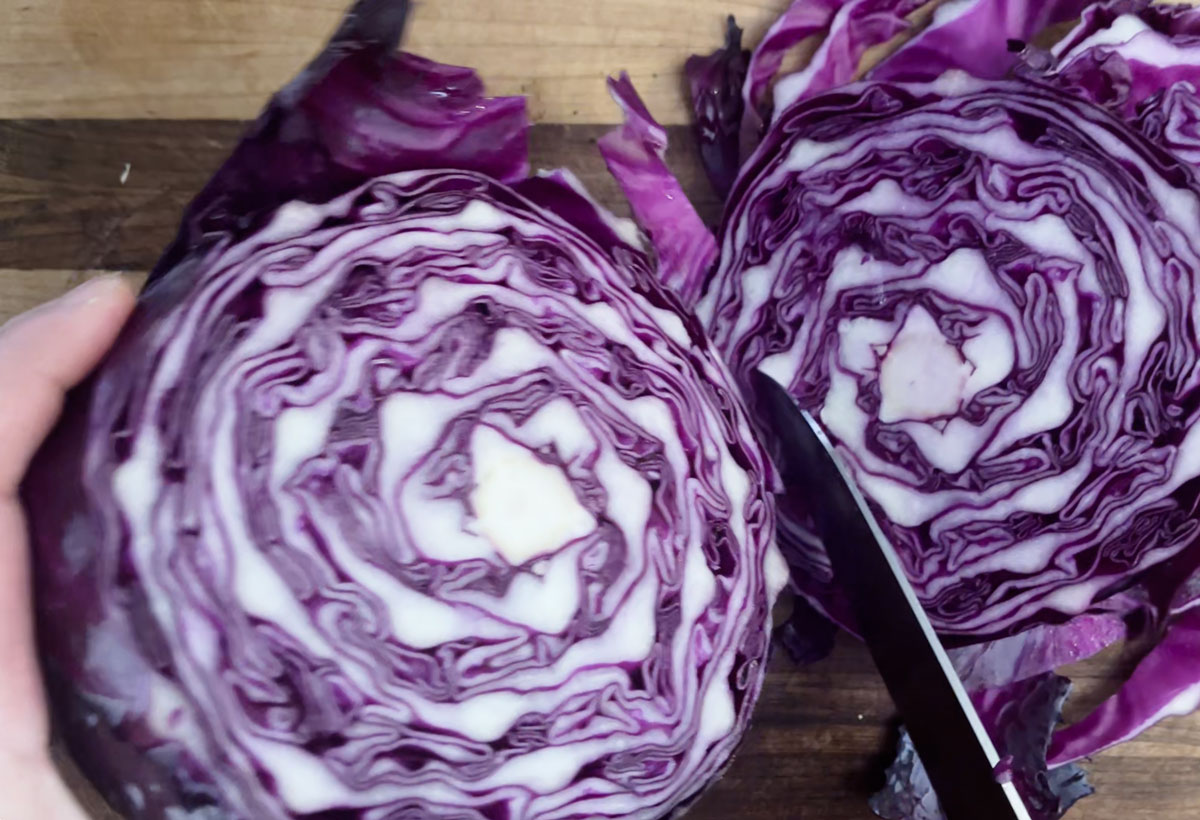
- While they bake, peel the sweet potatoes and arrange them on a pan under foil. Chop the cabbage.
- Put a pot of water on. When it boils, the quinoa goes in.
- Cook the ground beef in a skillet. When it’s done, block it up right away.
- Green beans come out, sweet potatoes go in. They take about an hour and twenty minutes.
- Cook the cabbage on the freed-up burner. Then block everything as it cools.
Door to door, that’s about 3.5 hours, and a lot of it is oven time you’re not standing over. You’re blocking the beef while the sweet potatoes bake. Blocking as you go matters for safety too, not just efficiency: the USDA says to get cooked food into the fridge or freezer within two hours, and portioning into small blocks is exactly the kind of shallow, fast-cooling division they recommend. A week of food sitting in one giant hot pot is where bulk cooking goes wrong.
Then the two-day truth from earlier: trays into the freezer overnight, and tomorrow the blocks pop out and get bagged by type in about ten minutes. Everything you just made stays safe in the freezer indefinitely at 0°F, with the best quality in the first few months, which is far longer than this week’s worth of food will last you anyway. If the tray part is new to you, how to use Souper Cubes walks through the portioning end of it.

Do you need to buy in bulk for bulk cooking?
No. A one-person bulk cooking week fits in a normal grocery cart at a normal store. Costco is overkill for this. Warehouse shopping solves a hundreds-of-servings problem, and you’re cooking for one person’s week, not a cafeteria. This is the myth that keeps people from starting: they think the entry fee is a membership card and a second freezer, when the entry fee is actually a baking dish and a few big bowls and pans to prep on.
The one thing genuinely worth buying in bulk is spices. Bought in quarter- to half-pound bags, they cost a fraction of what the little grocery-store jars charge by weight, and they keep long past any single week of cooking. A warehouse store works for this, but plenty of regular grocery stores have a bulk spice section that does the same job.
The food itself is cheaper than the Costco myth suggests. The example week (four pounds of ground beef, green beans, purple cabbage, quinoa, and sweet potatoes) runs about $48 with regular ground beef, or about $59 if you buy it grass-fed. The meat is the one real expense: four pounds gives you twelve protein blocks. Everything else is pocket change by comparison. The green beans and cabbage come to under $13 together for sixteen vegetable blocks, and the two carbs round it out for about $8. Across a week of weekday lunches and dinners, that pencils out to right around $5 a meal, and that’s conservative, since you’ll finish the week with leftover ingredients and a few extra vegetable blocks that roll into the next one.
Where quantity thinking does help is inside a single batch: if the pan is already dirty and the oven is already hot, cooking more of the same thing is nearly free. Scaling up a batch costs you almost nothing. Scaling up the number of different batches is what costs hours, which is exactly why the week above holds at five things, not ten.
How do you keep a week of the same food from getting boring?
Toppings and swapping the sides, mostly. Not a second blocked protein. The instinct when planning a bulk week is to cook two meats “for variety,” but the protein roster is short to begin with: beef, chicken, turkey, fish, tofu, and you’ve mostly named them all. One blocked protein is usually plenty, and the real variety lives in the vegetables, the carbs, and the fridge door.
You also don’t have to get every bit of protein variety from the freezer. Cooking a little fresh meat mid-week is quick, and some of the best options don’t block well anyway, like a couple of soft-boiled eggs or a tin of sardines. Keep a few of those around and one blocked protein never feels like the whole story.
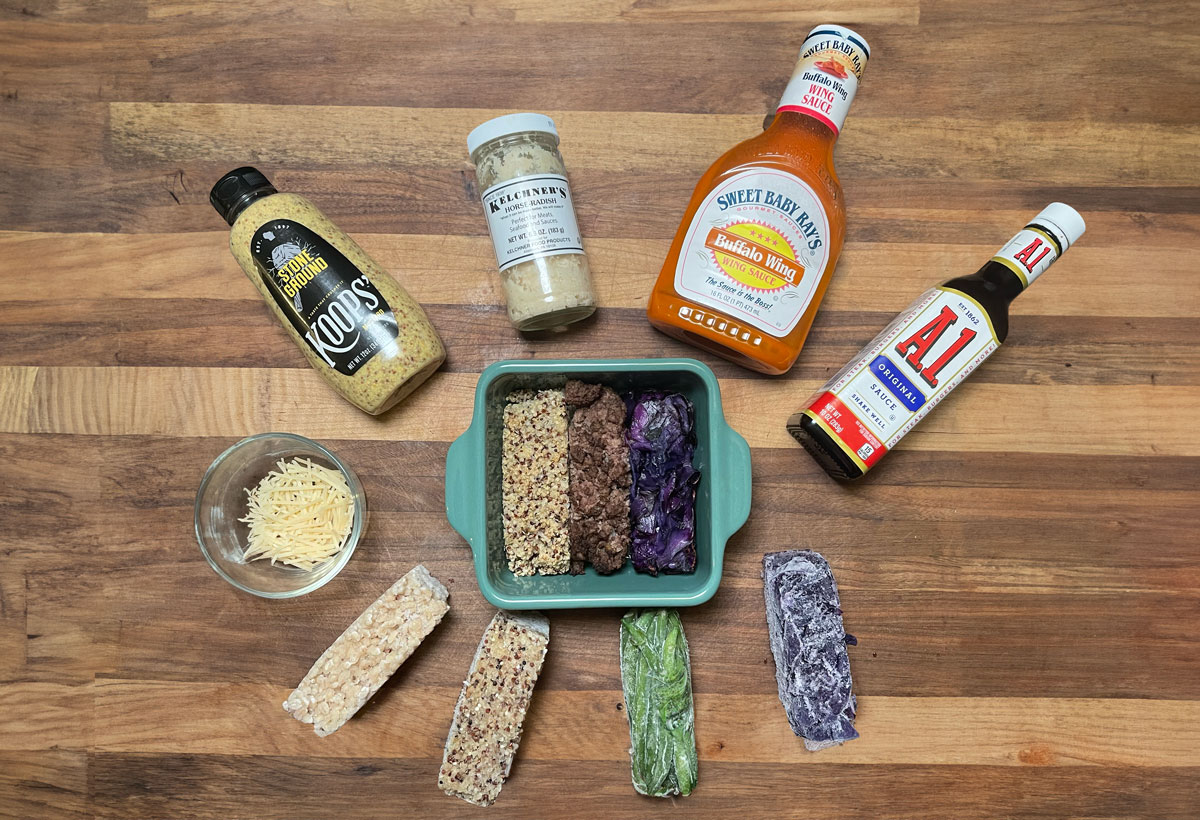
Here’s what that looks like in practice with one batch of ground beef. Night one it’s beef, quinoa, and green beans with sundried tomatoes on top. Night two, beef and sweet potato with red cabbage and a spoon of coarse mustard. Night three, swap in horseradish and it reads like a completely different dinner. Or stir a spoon of pasta sauce or barbecue sauce into the beef, add a handful of cheese, and it turns another direction entirely. Same block, several meals that don’t taste like a rerun. Two vegetables and two carbs already give you four base combinations; the toppings and sauces multiply from there.
A week of one protein doesn’t get old for me, and it might not for you either once the toppings are doing their job. If you want a second meat, add it. It’s cheap and fast, since meat cooks quickly. The real time sink in a bulk session isn’t the protein at all; it’s chopping vegetables. Vegetables are both where the variety lives and where the hours go, unless you keep them simple. Something like the covered-dish green beans barely costs you any prep. That’s the place to be realistic about how much you take on.
What about bulk cooking for a family?
For a family of four, let the weekend cook play a supporting role instead of trying to produce a whole week of finished dinners. Cooking the entire week for four in one session is possible if you keep the items simple, but it’s realistically an all-day affair, and it only really works if everyone’s happy eating the same few things all week. The more sustainable move is to use the session to stock the parts you don’t want to make on a weeknight, and cook the fast stuff fresh as you go.
In practice, that means batching what’s a pain to cook on the spot and leaving the easy things for during the week. Cook one big batch of ground meat and skim off it through the week; make rice fresh when you need it; and on a given night all you’re reheating is a vegetable block plus whatever you’re adding to it. The blocks become pre-made ingredients rather than pre-made meals, so you’re still cooking a little during the week if you want to. You’re just never starting from zero. That’s where the blocks quietly make a family week less complicated than it sounds.
The block system also solves the variety problem a family runs into, and this is where it earns its keep with more than one eater. It compounds: every component you add multiplies against the ones already in the freezer, so a drawer that started narrow gets broader every week without any single session getting bigger. The real payoff is that everyone builds a different plate from the same set of blocks, instead of the whole table eating one identical dinner.
Frequently asked questions
Frequently asked questions
What is the difference between bulk cooking and batch cooking?
How long does bulk cooking take?
How long does bulk-cooked food last in the freezer?
Is bulk cooking cheaper than cooking every day?
Do you need a chest freezer for bulk cooking?
Conclusion
Bulk cooking is one afternoon, honestly described: 3.5 hours of cooking, a night in the freezer, ten minutes of bagging, and then a week where dinner is 30 minutes of mostly oven time. One meat, two vegetables, two carbs. A regular grocery cart, not a warehouse run. Toppings doing the variety work so the session stays short.
If this is your first week, cook exactly the five things above and don’t improvise until week two. Once the rhythm clicks, the frozen block method gives the whole thing a structure that keeps running long after the novelty wears off, and that’s when the freezer starts answering the 6:45pm question for you.
Start this Sunday
Summarize the key takeaway, connect back to the block system if relevant, and point to one clear next step.
Get the Playbook →


Be the first to leave a comment