
The Complete Guide to Batch Cooking
Batch cooking turns 3-4 hours of work into weeks of meals from the freezer. Five categories, one combining rule, dinner in 30 minutes.
On this page
TL;DR
Batch cooking means cooking large quantities of food at once, portioning it into the freezer, and eating from that work for weeks. A typical session takes 3 to 4 hours. The frozen block method – five categories (protein, carbs, veg, meal, smoothie) combined with one rule (protein + carb + veg = balanced dinner) – turns dinner into a 30-minute pull from the freezer instead of a fresh start at 6:45pm.
Batch cooking exists because weeknight cooking happens under the worst possible conditions. You’re hungry, you’re tired, dinner is in 30 minutes, and you’re staring into the fridge at 6:45 on a Tuesday trying to make something out of nothing. The 6:45pm window is also the window where nobody cooks well.
The fix is moving the work out of that window. You spend a few hours one weekend cooking components and meals in bulk, portion everything into the freezer, and from then on dinner is a 30-minute pull instead of a fresh start. It’s the most powerful thing you can give your future self.
I’ve been batch cooking for ten years and built an app to run it. This guide covers everything I’ve learned about doing it well – what to cook, how long it lasts, the mistakes to avoid, and the system that finally made it click after a decade of refining it. By the end you’ll have a real plan you can start this weekend.
What is batch cooking?
Batch cooking means cooking large quantities of food at once to eat from later. There are different ways people do it – some batch and refrigerate for the week, some can or jar what they make, some dehydrate it. This guide is about batch cooking for the freezer, which is what the frozen block method is built around. I’ve been batch cooking for ten years and am delighted to have found a way with this system to really make it work for me.
You spend three or four hours making components – proteins, vegetables, things like rice or sweet potatoes – and whole meals like soups or casseroles, then portion and freeze everything so future-you has actual food to eat on a Tuesday at 6:45pm when you have nothing left to give.
When you meal prep, you spend Sunday afternoon assembling five identical chicken-rice-broccoli containers for the week. By Wednesday you’re sick of them. By Friday you’re ordering takeout while the planned food rots in the fridge. (I know – I tried that approach for years before I gave up on it.)
When you batch cook for the freezer, you spend the same Sunday afternoon making things differently. Some go in as components: shredded chicken, brown rice, sautéed greens – each portioned separately so you can combine them into different meals. Some go in as whole meals: a pot of chili divided into single portions, a tray of lasagna cut and wrapped individually, a batch of curry over rice.
Tuesday becomes chicken over rice with greens. Wednesday becomes the chili thawed and ready in 20 minutes. Thursday becomes a totally different combination depending on what you have left. Same Sunday afternoon, different meals all week.
The freezer is what makes this work. Meal prep assumes you’ll eat the food within 5-7 days. Batch cooking for the freezer stretches that timeline to months.
Properly portioned and stored, batch-cooked food stays usable for 2 to 3 months in the freezer per USDA Food Safety guidance. That’s what changes the math – you’re not just feeding this week, you’re slowly building a stash.
How is batch cooking different from meal prep?
| Approach | What you cook | When you eat it | How long it lasts |
|---|---|---|---|
| Meal prep | Complete meals | The same week | 5-7 days (refrigerated) |
| Batch cooking | Components and individual meals | Over the next 2-4 weeks | 2-3 months (frozen, safe longer) |
| Once-a-month cooking | About a month of meals in one intensive session | Over the next 2-4 weeks | 2-3 months (frozen) |
The systems aren’t mutually exclusive. You can do meal prep inside a freezer batch cooking system – freeze some of what you make this week alongside this week’s portions. The mindset difference is what matters: meal prep solves dinner for the week. Batch cooking for the freezer solves dinner for the months ahead.
Why does batch cooking work?
Batch cooking works because it removes the daily obligation to cook a fresh meal. I love cooking – I just don’t love having to cook every night, exhausted, at the end of a long day.
You’re not chained to the stove on a Tuesday when a hot meal is the last thing you have the energy to make. You’re not ordering takeout at 7pm because you can’t face one more dinner decision. The food is already there – you just have to heat it.
That sense of freedom is the biggest unexpected benefit I’ve experienced. After ten years of batch cooking, the most meaningful thing it’s given me isn’t time or money (though those matter too). It’s the ability to skip cooking when I don’t want to cook, without that meaning I order takeout or eat poorly.
The food waste problem goes away
In a normal kitchen, you cook on Sunday, eat as much as you can, and something is going bad in the fridge by Thursday – produce wilting, leftovers turning, a sauce you forgot you opened. Then there’s the pressure: eat that thing before it spoils, even if you’d rather have something else. An estimated 30-40% of food in the U.S. is wasted each year per USDA, and a large share of that happens at the household level.
Batch cooking moves food to the freezer, which buys you weeks instead of days. I almost never throw food away anymore. That low-level pressure to eat something before it spoils is just gone.
You can actually eat on time
If you’ve ever worked late and needed to cook from scratch, you know how this goes – dinner happens at 8:30pm, you eat too fast, you go to bed full. Batch cooking flips that. As long as you pull a few frozen portions out 30 minutes before dinner, you eat on time. No matter what the workday looked like.
Portions take care of themselves
When you freeze in standardized portions, you stop thinking about how much to make or how much to eat. You take out one portion per person, maybe two, and that’s the meal. I don’t overeat anymore. I don’t go hungry between meals either – reaching for a quick portion is easier than reaching for chips.
The freezer mindset takes a little getting used to
The honest part: this isn’t exactly like cooking dinner every night. You miss the smell of something cooking, the bubbling pot, the kitchen activity. But you get something better in return – actually eating, on time, every time you need to.
It also doesn’t have to be all-or-nothing. Some of the best meals I make are a couple of frozen portions plus a side salad or some fresh cherry tomatoes – frozen for the heavy lifting, fresh for the bright notes.
How do you start batch cooking?
To start batch cooking, pick one or two big projects you want to make, prep the ingredients (often the night before), cook everything in one session, portion into silicone trays, and freeze. The whole thing is a marathon, not a sprint – how far you go in any single session depends on how much you’re willing to run that day.
If you’re going to make a mess, make a big mess. Once the counter is covered in cutting boards and pots are going on the stove, you might as well batch as much as you can. The setup time and cleanup time are the same whether you cook one thing or four.
Here’s the actual order of operations.
Step 1: Clean the kitchen and plan your session
Start with a clean kitchen – a clean counter is the difference between a productive session and chaos. If your kitchen isn’t clean, that’s part of the prep. Handle it first.
Then pick 1-2 big projects, max. A typical session might be a giant batch of ground beef plus a pressure cooker of beans plus roasted sweet potatoes. Or chicken thighs plus sautéed bell peppers plus rice. You’re not making everything in one day – you’re building your block library over multiple sessions.
Step 2: Prep your ingredients (the night before is fine)
The boring chopping work – peeling, coring, cleaning – can absolutely happen the day before. Sweet potatoes peeled in front of the TV. Onions deskinned at the kitchen table.
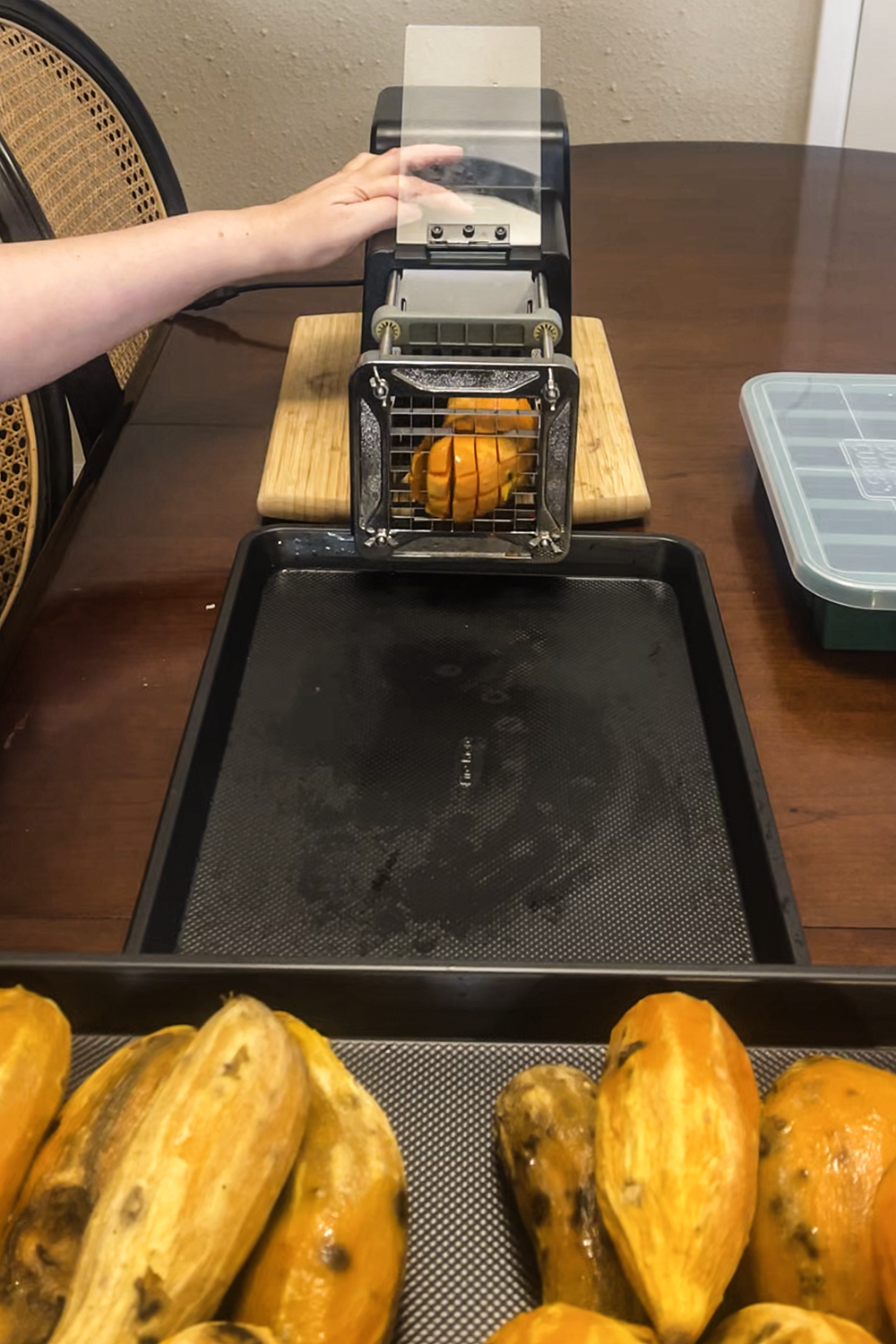
Bell peppers cored and washed. A fry cutter or food processor saves a lot of time when you’re prepping a lot of one thing.

This is honestly the part most people skip and regret. If you start your batch session with a pile of vegetables that need chopping AND meat that needs cooking AND a pressure cooker to set up, you’re going to feel overwhelmed by hour two. Pre-prep buys you breathing room.
Step 3: Start cooking – pressure cooker first
Start with whatever takes the longest. Pressure cooker first – beans, chicken thighs or bones for soup base, anything that benefits from long, low cooking. Then stovetop or oven for the faster items.
Ground beef takes about 45 minutes for a big batch. Roasted veg takes 30 to 45 minutes for a sheet pan or two. Sautéed veg is just a few minutes per pan.
One of the great things about batch cooking multiple things – if you’re making a day of it – is being able to reuse the same pan. Cook the onions first, push them aside, cook the bell peppers in the same pan, push them aside, cook the meat in the same pan with all that flavor already there. One pan, three components, one wash.
Step 4: Use the cooking time
Cooking time is dead time if you let it be. While the pressure cooker is going and the oven is on, find something to do:
- Clean the kitchen as you go
- Portion out spices for tomorrow’s cooking
- Wash containers and silicone trays so they’re ready for filling
- Prep ingredients for the next thing you’re cooking
A two-hour batch session feels like four hours if you stand around watching the pressure cooker. It feels like one hour if you keep moving.
Step 5: Portion into silicone trays
Once everything is cooked, let it cool a few minutes – not all the way, just enough that you’re not putting boiling food into the freezer. Then portion into silicone trays. Half-cup portions for components like chicken, beans, or sautéed peppers. One-cup portions for whole meals like chili or curry.
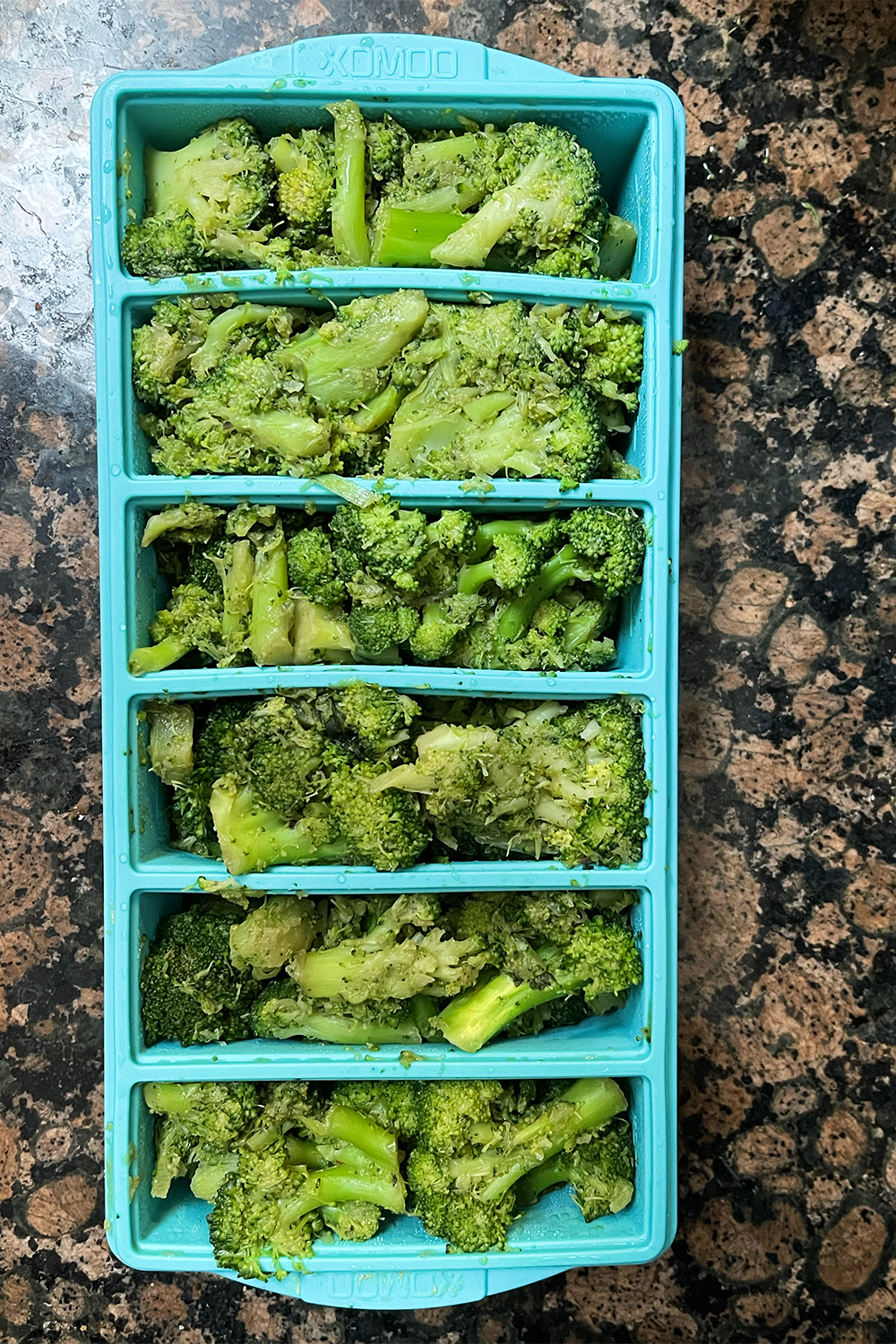
Leave the trays uncovered for the first hour or so. Putting lids on while the food is still warm traps steam, which can mess with the freeze.
Step 6: Freeze, then transfer to bags (a day or two later)
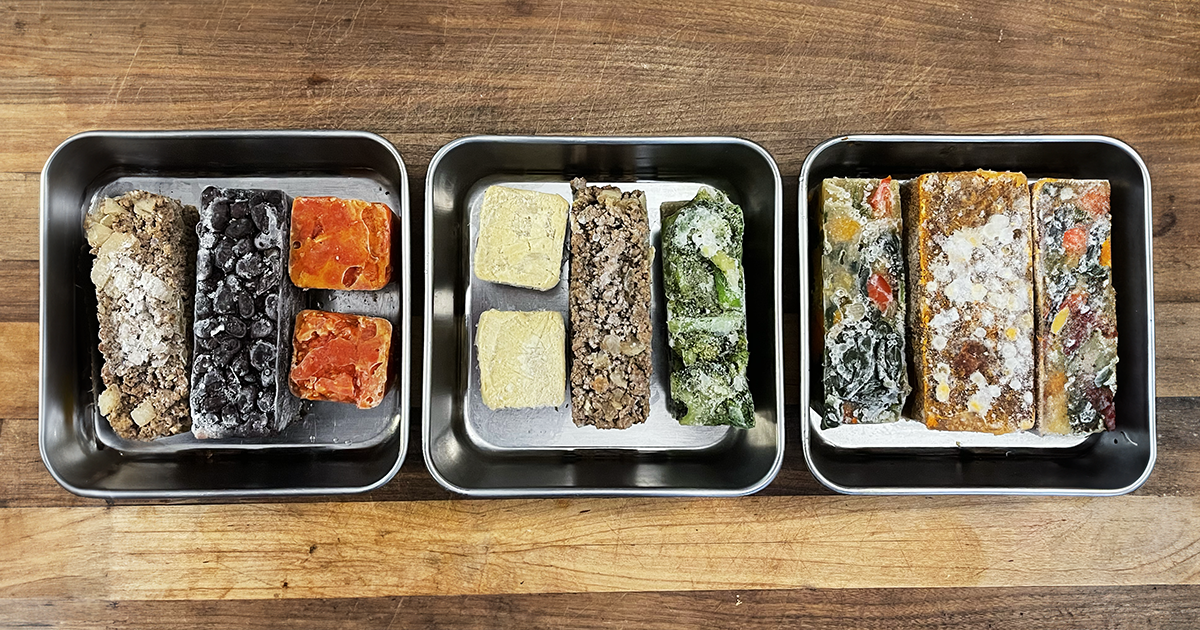
Slide the trays into the freezer. The next day or two, pop the frozen blocks out of the silicone trays and transfer them into freezer bags – one quart each. Label each bag by content and date. Now you’ve got a bag of chicken blocks, a bag of bean blocks, a bag of sautéed pepper blocks, all ready to grab from the freezer one at a time.
The freezer doesn’t care how you got there. Whether it took you four hours on a Sunday or two shorter sessions across a weekend, the finished blocks are the same.
What is the frozen block method?
The frozen block method is the batch cooking system I use, named for what comes out of it: standardized frozen blocks of food, portioned to combine into balanced dinners. It’s smaller than it sounds – five categories of blocks, one rule for combining them. Once those two things live in your head, you can run this for the rest of your life.
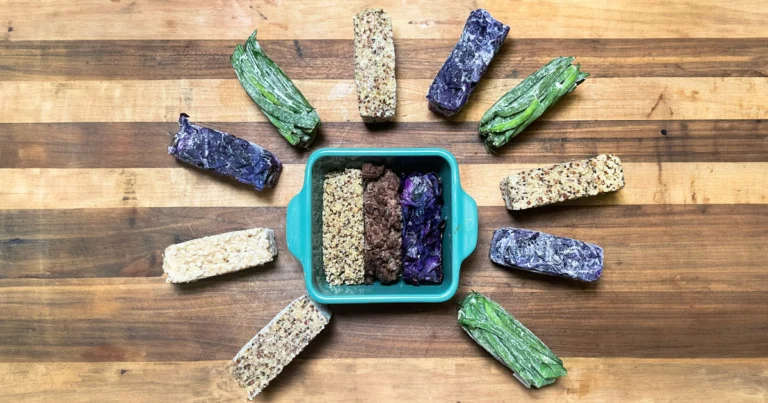
The five categories are Protein, Carbs, Veg, Meal, and Smoothie. The first three – Protein, Carbs, and Veg – are the foundation. They’re ½-cup portions, batched in sets of six, and they’re what I rely on most.
The combining rule is the rest of the system: one protein + one carb + one veg = balanced dinner. Pull three blocks from the freezer, heat them, eat. No recipes, no meal plans, no decisions at 6:45pm. The three-block pull is the plan.
Meal blocks and Smoothie packs are the other two categories. They work differently from the foundation – meal blocks are full dinners that can stand alone or stretch further when you pair them with foundation, and smoothie packs are pre-portioned for one quick blend. Both have their own rules and rhythms, which is where the Playbook picks up.
What this gets you is a freezer that does the work for you. You open the door, see categories you understand, pull three blocks, and dinner is 30 minutes away – even on a Tuesday at 6:45pm.
→ The Frozen Block Method Playbook walks you through every category, every portion size, every combining rule, and the four cooking modes that keep the system running through real life. It’s about a 20-minute read. You could start this week.
What’s best to batch cook?
The best things to batch cook are the foundation building blocks – a protein, a starchy carb, and a vegetable mix – plus an easy meal block or two like chili. Start there. Once those are running, add the multipliers: caramelized cherry tomatoes, garlic, anything that adds flavor or saves time on every plate.
Start with the foundation: protein + carb + veg
A typical foundation rotation might look like ground beef or shredded chicken, sweet potatoes or black beans, and a vegetable mix like spinach with mushrooms and onions. Cabbage works too. So does a roasted sheet pan of bell peppers.

The point is to have one of each category in the freezer so you can pull three blocks and have dinner 30 minutes later. The full breakdown lives in the Playbook.
For carbs, I also love black rice and barley blocks – both freeze well and bring something different than rice or sweet potatoes. Barley is a nice slow-carb alternative when you want something chewy. Rice, quinoa, and couscous freeze fine too; they cook in under 30 minutes anyway, so I’ll sometimes just make a small fresh batch instead.
And when I’m running low on carb blocks, I’ll sometimes make a small pot of mac and cheese to stretch what’s left. It pairs surprisingly well with ground beef and a green vegetable, and it makes eating mac and cheese acceptable as an adult.
Easy meals pull double duty
One-pot meals like chili and white chili are some of the easiest things to batch. They freeze and reheat beautifully – and they pair with foundation blocks to stretch into multiple dinners. A chili block plus a rice block plus a spinach mushroom block is a different (better) meal than chili on its own.
Right now my freezer has ground beef, a spinach veggie mix, chicken tortilla soup, and a white chili. It’s getting low, but even low, the pairings keep working – southwest beef in a quick salad, a chili block over pasta cooked fresh.
Caramelized cherry tomatoes are the secret weapon
In small blocks they’re sweet, jammy, and intense. One block on top of a chicken-and-sweet-potato bowl turns it into a real dinner. They go further than almost anything else in the freezer for the flavor return.

The kitchen helper: garlic in 2-tablespoon blocks
This one’s not really food you eat on its own – it’s a cooking aid. Mince 5 whole heads of garlic at once, portion into 2-tablespoon blocks, freeze. Now every recipe that calls for garlic skips the chopping step. It sounds small. It is not.
What not to batch
A couple of things just don’t work in the freezer:
- Pasta. It comes out sad. Cook it fresh when you reheat the rest of the meal – pasta takes 10 minutes anyway.
- Anything you eat fresh. Salads, raw vegetables, bread. Anything where crispness or freshness is the point.
Starting from scratch?
Pick a meal you already cook often. Look at it through the lens of veg + protein + carb. If you love a hearty veggie-and-meat spaghetti, batch the meat sauce, freeze the vegetables, and cook the pasta fresh when you reheat. If you love chili, that’s basically a perfect starter recipe – one pot, easy to freeze, pairs with everything.
My go-to combo: a cabbage or spinach-mushroom mix + ground beef or shredded chicken + sweet potatoes or black beans, finished with feta and ancho chili sauce, or whatever sauce makes the meal feel like yours.
How long does batch-cooked food last?
Properly frozen, batch-cooked food stays good for up to 6 months. The USDA says it’s safe indefinitely at 0°F, but quality starts dropping after about 3 months. My honest rule: eat it within 6 months and you’ll never notice a difference.
Labeling: keep it simple
I just write the name of the meal on the bag. No date – I eat through my blocks before the 3-6 month window becomes a concern. If you’re new and worried about losing track, add a date, but don’t overthink it.
A note on bags: I prefer silicone bags (reusable, less plastic), but labels don’t stick well to silicone and china markers don’t write reliably on them either. Plastic freezer bags are easier – permanent marker, reusable for the same type of block. I use silicone when I can.
Rotation: let the drawers do the work
I keep blocks in freezer drawers organized by category – one for protein, one for carbs, one for veg, one for meals. Overflow and flavor bombs (the garlic and tomato cubes) live in the side door. With a drawer-per-category setup, rotation takes care of itself: you reach into the protein drawer, grab what’s there, repeat. (When the CookBlocks app launches, the inventory tracking will handle this automatically.)
Souper Cubes are the trays I actually use
For foundation blocks, the 1/2-cup Souper Cubes tray is exactly the right size – one foundation portion per cube. For meal blocks, I use the 1-cup tray. The trays surprise people with how much food they hold; a full one gets heavy, and the silicone holds up beautifully under the weight. They’re sturdy, well-designed, and they stack neatly in the freezer. If you’re starting out and need to pick trays, these are what I’d buy first.
The outer bound
If you find a block in the back of your freezer that’s been there longer than 6 months, it’s probably still safe to eat – USDA confirms that food at 0°F stays safe indefinitely. But quality drops the longer it sits. Six months is the practical line I draw.
What batch cooking mistakes should I avoid?
The biggest batch cooking mistakes have nothing to do with the cooking part – they’re about scope, timing, and tools. Here are the five I’ve seen (and made myself) over ten years of running this system.
1. Buying more meat than you can cook fast enough
The single most expensive mistake. You haul home four pounds of chicken and two pounds of ground beef on Saturday, plan to batch Sunday, get through half of it, and by Tuesday the rest is on the edge. Ground meats need to be cooked or frozen within 2 days per USDA, and that window closes faster than people expect. Cook the meat upfront if you can; at minimum, freeze the raw meat if your cooking window shifts.
2. Trying to cook everything from the beginning
Don’t show up to your first batch session with eight recipes. Do one big batch of the foundation – a protein, a carb, a vegetable mix – and get a feel for the work. If you need variety from the start, scale down: smaller batches of two or three things rather than full batches of one. You can always batch more next weekend.
3. Waiting too long to portion your food into blocks
The whole effort breaks down right at the end. You cook for hours, the food is great, you sit down to eat – and the rest goes into a giant container “for later,” only for half of it to be off by the time you remember. Block your food the same day you cook it. Even if some of it goes into containers instead of trays at first, get it portioned and into the freezer before it can spoil.
4. Trying to chop everything by hand
I held out for a long time. Then I bought a fry cutter and ran sweet potatoes, bell peppers, and onions through it – hours of chopping became minutes. If you’re batching a lot of vegetables, the right tool is the difference between a session you’ll repeat and one you’ll quietly never do again.
5. Seasoning every block for one specific cuisine
If every block of ground beef is heavily Italian-seasoned, you’ve made Italian ground beef, not flexible foundation. Lean on broad spices like cumin, garlic, salt, and mild chili for the blocks themselves, and add cuisine-specific punch at meal time with sauces. The Playbook goes deep on this; the short version is season flexibly, sauce specifically.
Frequently asked questions
How long does it take to batch cook for the week?
What tools do I need to start batch cooking?
Can I batch cook without a freezer?
How much money does batch cooking save?
What if I don’t like eating leftovers?
Can I batch cook for one person or for a family?
What’s the best way to reheat batch-cooked food?
Start small, this weekend
Batch cooking changes what dinner means. Once a stocked freezer is doing the heavy lifting, the 6:45pm panic stops happening, food stops going to waste, and the time you spend cooking is time you actually chose to spend.
You don’t need a full freezer or a perfect system to start. Pick one weekend, one protein, one carb, one vegetable mix. Cook them, portion them into trays, freeze them. That’s a Sunday’s worth of work that gives you a week of dinners that arrive without thought.
The frozen block method scales from there. Once the foundation is in your freezer, everything else – meal blocks, smoothie packs, flavor multipliers – builds on top of it. The full system is in the Playbook when you’re ready for it.
Save this guide for later


Be the first to leave a comment